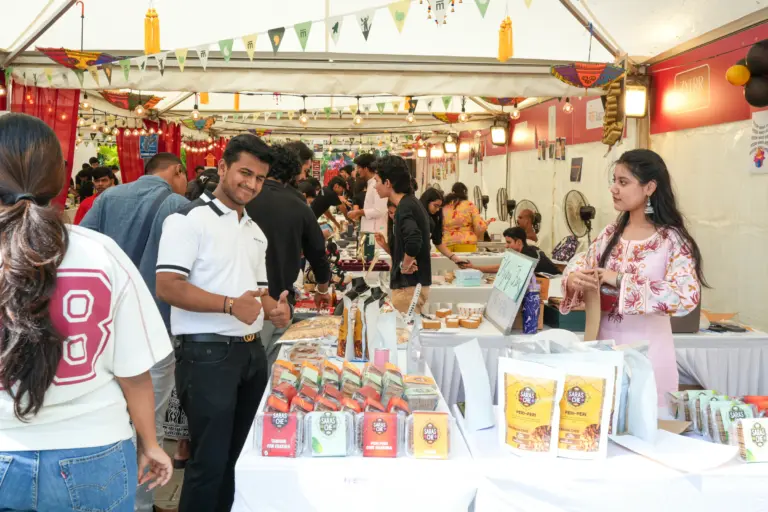
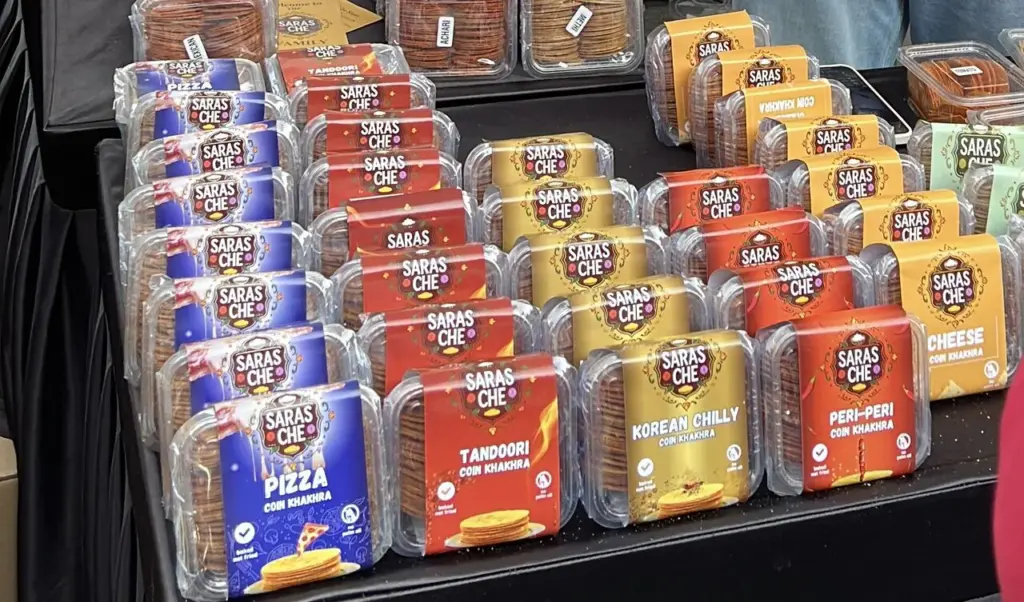
At Mesa School of Business, our UG students Aaradhy Jani and Arihant Jain co-founded Saras Che during our Build Your Own Business (BYOB) exercise, which asked them to create and sell a direct-to-consumer brand. They chose coin khakhra, a familiar Gujarati snack in a smaller format. During BYOB, the venture generated ₹7 lakh in revenue, included in the ₹75 lakh collective revenue generated by our first cohort’s 24 teams. The work did not end with the classroom sprint: the founders continued developing the product and finding ways to sell it.
Aaradhy grew up with khakhra in his Gujarati family. On Saras Che’s site, the brand explains why it made the snack coin-sized: a full-size khakhra needs a plate and two hands, while the smaller version can be eaten on the move. That decision shaped the product, the packaging and the customers the founders first approached.
From the BYOB brief to a first stall
In the founder narration shared with us, Aaradhy describes speaking to vendors in Gujarat, obtaining the first inventory, developing the branding, registering the business and setting up a stall. He recalls that, during BYOB, the first stall sold out after about ₹20,000 in sales on day one. Each step required an operating decision: what the product should be, who could make it, how it should appear on a shelf and whether a customer would pay for it.
The ₹7 lakh generated during BYOB records business revenue, not the founders’ profit or individual earnings. It gives a measurable point in a longer story that began with a student brief and continued as a business beyond it.
On the brand’s own website, Saras Che explains the product choice more fully. Its coin khakhra aims to be easy to snack on with one hand. The company describes whole wheat, real spices and products without palm oil or maida. Those choices gave the founders something specific to demonstrate when they asked retailers to make room for a new brand.
Learning to earn the next order
Arihant’s account of shop visits begins with a rejection before a sample was even opened. He describes returning to retailers, learning which product reactions mattered and recognizing that a shopkeeper also had to trust the team behind the pack. Questions about whether stock would move, whether the supplier would answer a call and how returns would be handled became part of selling the snack.
Our Mesa Startup Lab portfolio describes the first placement as one store in JP Nagar, Bengaluru, on consignment. The brand has reached 12+ stores to date. These milestones show the move from one retailer taking a chance to a broader store presence built through the founders’ continued selling.
Taking the brand into other settings
In Aaradhy’s public account of CMPL Expo in Mumbai, the team took a stall and presented khakhras, bhakhris and ragi chips. He describes retail, business-to-business and gifting as channels they were developing. That account shows how the founders moved beyond one type of buyer and had to explain the same brand to people making different purchasing decisions.
A household considering a snack, a retailer deciding what deserves shelf space and a business planning a gift order each needs a different answer. The founders’ work across these settings therefore involves more than repeating a pitch. It means choosing the right product range and presentation, keeping stock available and learning which customer problem each channel actually solves.
What this teaches through our UG program
Our BYOB brief set the starting task: choose a product and take it to market. The founders did the sourcing, branding, selling and later expansion themselves. Saras Che’s path shows how practical business learning changes with each stage: a first sale tests the offer; a growing retail presence tests the product and operations; a new channel tests whether the team can explain and fulfil a different kind of demand. Mesa Startup Lab’s Saras Che profile names both co-founders.
Explore the founders’ public accounts, the Saras Che website and our UG program page if you want to see the product and understand where BYOB fits in our four-year learning experience. The venture’s results are its own; the wider program gives students the opportunity to make decisions, test them and learn from what happens next.